Learn Cube Notation and Try This - R U2 R' | L' U2 L
Learn cube notation and practice the R U2 R' then L' U2 L algorithm on a 3x3 Rubik's Cube to observe piece movement.


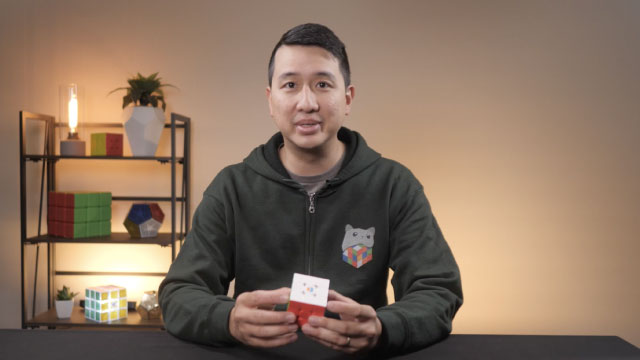

Step-by-step guide to Learn Cube Notation and Try This - R U2 R' | L' U2 L
Step 1
Place the cube so the white face is on top and the green face is facing you.
Step 2
Learn the meaning of R by saying or remembering: R means turn the right face clockwise 90 degrees.
Step 3
Learn the meaning of R' by saying or remembering: R' means turn the right face counterclockwise 90 degrees.
Step 4
Learn the meaning of U2 by saying or remembering: U2 means turn the top (up) face 180 degrees.
Step 5
Learn the meaning of L by saying or remembering: L means turn the left face clockwise 90 degrees.
Step 6
Learn the meaning of L' by saying or remembering: L' means turn the left face counterclockwise 90 degrees.
Step 7
Make sure the cube is fully solved so each face is one solid color before you start.
Step 8
Carefully perform the moves R U2 R' slowly and in that exact order.
Step 9
Look closely at the cube and point out which stickers moved and which pieces (edges or corners) changed places.
Step 10
Perform the moves R U2 R' one more time to return the cube to the solved state.
Step 11
Carefully perform the moves L' U2 L slowly and in that exact order.
Step 12
Look closely at the cube and point out which stickers moved and how those pieces changed places.
Step 13
Perform the moves L' U2 L one more time to return the cube to the solved state.
Step 14
Share a photo or description of what you observed and learned about the piece movements on DIY.org.
Help!?
What can we use if we don't have a standard 3x3 Rubik's Cube?
If you don't have a 3x3 cube, use a 2x2 cube or a virtual cube app and still set white on top and green facing you before practicing the R U2 R' and L' U2 L moves.
I followed R U2 R' twice but the cube didn't return to solved—what should I check?
Check that the cube was fully solved with white on top and green front before starting, confirm you turned the correct faces (right for R/R' and top for U2), and make sure U2 was a full 180° and the moves were done in the exact order R U2 R'.
How can I adapt this activity for younger or older kids?
For younger children, simplify by practicing single moves like R or U2 hand-over-hand and using a 2x2 or color diagrams, while older kids can time themselves, record which edges and corners moved after R U2 R' and L' U2 L, and analyze the piece cycles.
How can we extend or personalize the activity after completing R U2 R' and L' U2 L?
Extend the activity by photographing the cube before and after each algorithm, labeling which stickers, edges, or corners changed places, inventing your own two-move sequences to test, and sharing annotated photos and observations on DIY.org.
Watch videos on how to Learn Cube Notation and Try This - R U2 R' | L' U2 L
How to Solve a Rubik's Cube [Best Method 2025]
4 Videos
![How to Solve a Rubik's Cube [Best Method 2025]](https://img.youtube.com/vi/PW2J8IblczM/mqdefault.jpg)
How to Solve a Rubik's Cube [Best Method 2025]
Learn How to Solve a Rubik's Cube in 10 Minutes (Beginner Tutorial)
How to solve a Rubik's cube | The Easiest tutorial | Part 2
Easiest Solve for Rubik's Cube | Step 7 | Beginners Guide
Facts about Rubik's Cube notation and algorithms
🧩 There are 43,252,003,274,489,856,000 possible positions on a 3×3 Rubik's Cube — that's over 43 quintillion!
🧑🔬 The standard notation used for writing cube moves is called Singmaster notation, named after David Singmaster who helped popularize it.
🔁 Short sequences like R U2 R' and L' U2 L are great for watching how a few pieces rotate or swap — perfect for learning piece movement!
⏱️ Top speedcubers in competitions regularly solve a 3×3 in under 4 seconds, thanks to memorized algorithms and fast turning.
🧮 All legal Rubik's Cube moves form a mathematical group, which is why you can combine, invert, and analyze algorithms systematically.
How do I teach a child to learn cube notation and practice R U2 R' then L' U2 L?
What materials do I need to try the R U2 R' | L' U2 L activity?
What ages is learning cube notation and practicing these algorithms suitable for?
What are the benefits of practicing the R U2 R' and L' U2 L algorithms?
